




When it comes to exercise, so many people — beginners; die-hard enthusiasts; reluctant participants; and everyone in between — are searching for holy grails: workouts that involve the least amount of time and effort and offer maximum results.
We live in the most scientifically advanced age of fitness. Exercise is a multibillion-dollar industry, and a lot of that money is spent on new research and development of new technology. If there were an easier way to get the benefits of a squat or a pull up without having to actually do a squat or a pull-up, you’d think we would’ve found it already.
Despite the absence of a magic pill or a one-minute, low-impact total body workout that will burn fat, build muscle, and prevent all serious health problems, the industry is full of savvily marketed plans and potions, promising the world for just a little bit of time and work.
The latest trendy regimen to fall into this category is the cardio workout known as 12-3-30. Devotees say that 12-3-30 lives in that ideal intersection of minimal effort and maximum results.
Could this be true? Have we unlocked exercise’s biggest secret? Or is this yet another lie perpetrated by Big Treadmill?
The coaches and personal trainers I spoke to said 12-3-30 is a net positive. People moving their bodies is generally better than people not moving their bodies, and anything that gets folks exercising is a good thing. But they also believe that 12-3-30 offers a look into how people have traditionally thought about exercise as being complicated, and how much simpler it can be.
What is 12-3-30?
No one alive today can truthfully claim they invented walking uphill. But fitness influencer Lauren Giraldo is largely credited with rebranding this physical act as 12-3-30. Giraldo posted a YouTube video about 12-3-30 in 2019; in 2020, she claimed that walking on the treadmill at a 12 percent incline at the speed of 3 mph for 30 minutes helped her lose 30 pounds and keep the weight off. In an interview with Good Morning America, Giraldo said she began using the 12-3-30 formula because it was a way to work out that wasn’t intimidating.
The nice thing about 12-3-30 is that it’s simple. There are a finite number of settings on a treadmill, and the most difficult thing about this routine is remembering which number goes where. The incline is set at 12. The speed input is where the three goes. And 30 is the number of minutes needed to complete this ritual.
“12-3-30 works for what it was designed to do: a low-impact cardio workout that’s easy to repeat,” Charlee Atkins, a certified personal trainer and the founder of the guided exercise app Le Sweat, told Vox. “I’d categorize 12-3-30 as LISS, or low intensity steady state cardio.”
I tried 12-3-30 at the gym this week and was surprised: I didn’t expect walking at this seemingly measly pace to be difficult enough to work up a sweat.
Atkins explained that 12-3-30 and other LISS routines are effective because they allow you to get your heart rate up with relatively lower effort and less wear and tear on your body than something like running. This makes 12-3-30 particularly attractive to beginners, folks coming back after an injury or extended break, and anyone who wants to do the recommended amount of cardio for better health but doesn’t want to make it their full-time job.
James McMillian, a certified personal trainer and president of Tone House, a strength and conditioning facility in New York City, agreed with Atkins that 12-3-30 is good for a lot of people. Because it doesn’t require a particularly high skill level and is relatively easier on joints, its barrier to entry is lower. People turned off by more challenging forms of cardio, like running or group cycling classes, may find 12-3-30 more doable, which could lead to more consistency.
“You’re walking at an incline, so your heart rate stays up, you’re burning calories, and you’re getting some lower body endurance work in without beating yourself up,” McMillian said. “The more you remove friction, the more people stay consistent.”
I tried 12-3-30 at the gym this week and was surprised: I didn’t expect walking at this seemingly measly pace to be difficult enough to work up a sweat. Yes, 12-3-30 is super simple (almost annoyingly so), but it’s not really something you can coast through either. The pace is just a smidge above a brisk walking speed, the kind you would use to pass someone lollygagging in front of you on a sidewalk. The incline feels like a steep-ish hill. And while it certainly isn’t as challenging as the spinning or HIIT classes that I’ve taken, I did work up a sweat. (I generally don’t trust treadmill calorie counts but, for what it’s worth, the machine told me I had burned 390 calories.)
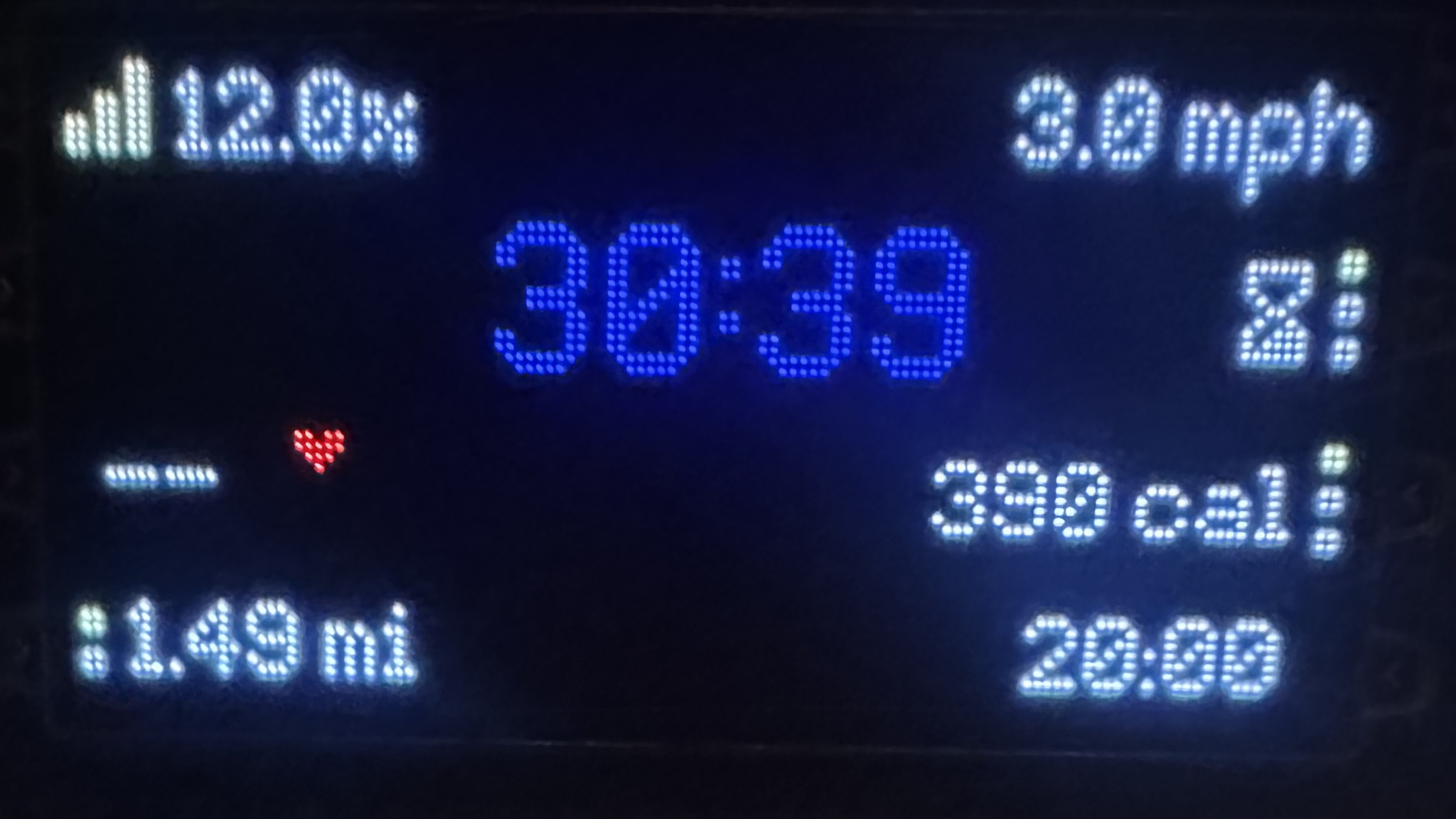
The experts I spoke to told me that to really get the most of the workout, you shouldn’t hold on to the treadmill’s hand rails. If you take that advice, it makes for a cardio experience that’s uncomfortable enough that you actually have to pay attention (I couldn’t text or scroll on my phone while doing it) but wasn’t impossible to finish either.
While experts I spoke to said that 12-3-30 isn’t a magic bullet and strength training might be more beneficial if your goal is getting stronger or enhancing athletic performance, there’s also a saying in the industry that the best workout is the one that you actually do. 12-3-30 is plan that a lot of people can perform consistently. By that standard, it’s a good one.
How much of 12-3-30 is just great marketing?
While effectiveness and consistency are crucial components, perhaps the biggest factor when it comes to 12-3-30’s popularity is that it’s easy to sell.
“12-3-30, it’s like the $5 footlong,” Bobby McMullen, a personal trainer and founder of the fitness app Adonis, told Vox. McMullen’s app matches clients with personal trainers based on goals, budget, and location, and he spends a lot of time thinking about how to meet gym goers where they’re at.
McMullen pointed out that workouts like P90X and Hard 75 become immensely popular in part because of how they’re packaged. It turns out that some people enjoy when their workouts, like their sandwiches, feature a numerical identifier. Branding matters, in part because partaking in the hot, number-named workout that everyone else is posting about can be a form of motivation.
“It sticks with you, so you know exactly what to do,” McMullen said. “You press a few buttons, you don’t change it for 30 minutes. It’s just a very catchy viral workout.”
McMullen and the other experts I spoke with noted that the gimmick of 12-3-30 also works because of the simple fact that many people go to the gym and either don’t know what to do or want/need to be told exactly how to use their time. Working out is an escape for a lot of folks, and who wants to think when they’re actively trying not to think?
Unlike the allure of bootcamps and other workouts that are proud of pulverizing you, 12-3-30’s charm is that it’s supposed to be easy enough — something that a wide swath of people can, in theory, accomplish. Its approachability is its strength, and a big part of why it’s so popular. McMullen said that one could even customize the program, and tinker with the speed to make it as easy or as difficult as needed. (But, he said, “going steeper is crazy.”)
“Moving your body at all is a win, and I will not, nor should any trainer, pooh-pooh any sort of overly marketed three-number system that gets you to move your body,” McMullen said, adding that the most important thing about 12-3-30 is that it’s showing people that working out doesn’t have to be as complicated as it seems.
“Whatever you can fit in is better than nothing,” he said. “If it’s all you have time for, run up that hill like Kate Bush, baby.”
Or, you know, walk.
Recent Comments