




President Donald Trump has put the US economy through the wringer.
Since taking office, he has:
- Imposed large and evershifting tariffs on imports, thereby driving up consumers’ costs and businesses’ uncertainty.
- Engineered a collapse in both legal and unauthorized immigration, which has undermined growth and labor specialization.
- Manufactured a global energy crisis that has pushed up Americans’ gas prices while threatening to plunge the world into a recession.
And yet, the American economy keeps trudging forward like a gut-shot zombie, damaged but undeterred by the bullets it has absorbed.
US GDP rose at a 2 percent annual rate in the first quarter of 2026 and a 2.1 percent pace in 2025, far outstripping growth in most other advanced economies. Meanwhile, America’s unemployment rate remains low by historical standards at 4.3 percent. And wages rose faster than inflation throughout 2025.
To be sure, the economic indicators aren’t all sunny. Last month, for the first time since 2023, real wages in the US fell as annual inflation hit 3.8 percent.
Nevertheless, if you told an economist in January 2025 that America’s new president would launch a haphazard global trade war, throttle legal immigration, and launch a conflict with Iran that indefinitely shuttered the Strait of Hormuz — then asked that expert to guess what the US economy would look like in May 2026 — they almost certainly would have sketched a far grimmer scenario than the one we’re currently living through.
Some will look at all this and conclude that Trump’s trade, immigration, and foreign policies weren’t that costly after all.
Another interpretation, however, is that Trump could have presided over a pristine economy, if he’d simply refrained from increasing import prices, reducing labor-force growth, and launching a war of choice near the aorta of the global energy market.
One could call this the “We had a good thing” account of Trump-era economic performance, after Mike Ehrmantraut’s much-memed scolding of the self-sabotaging drug lord Walter White in a late season of the AMC series Breaking Bad.
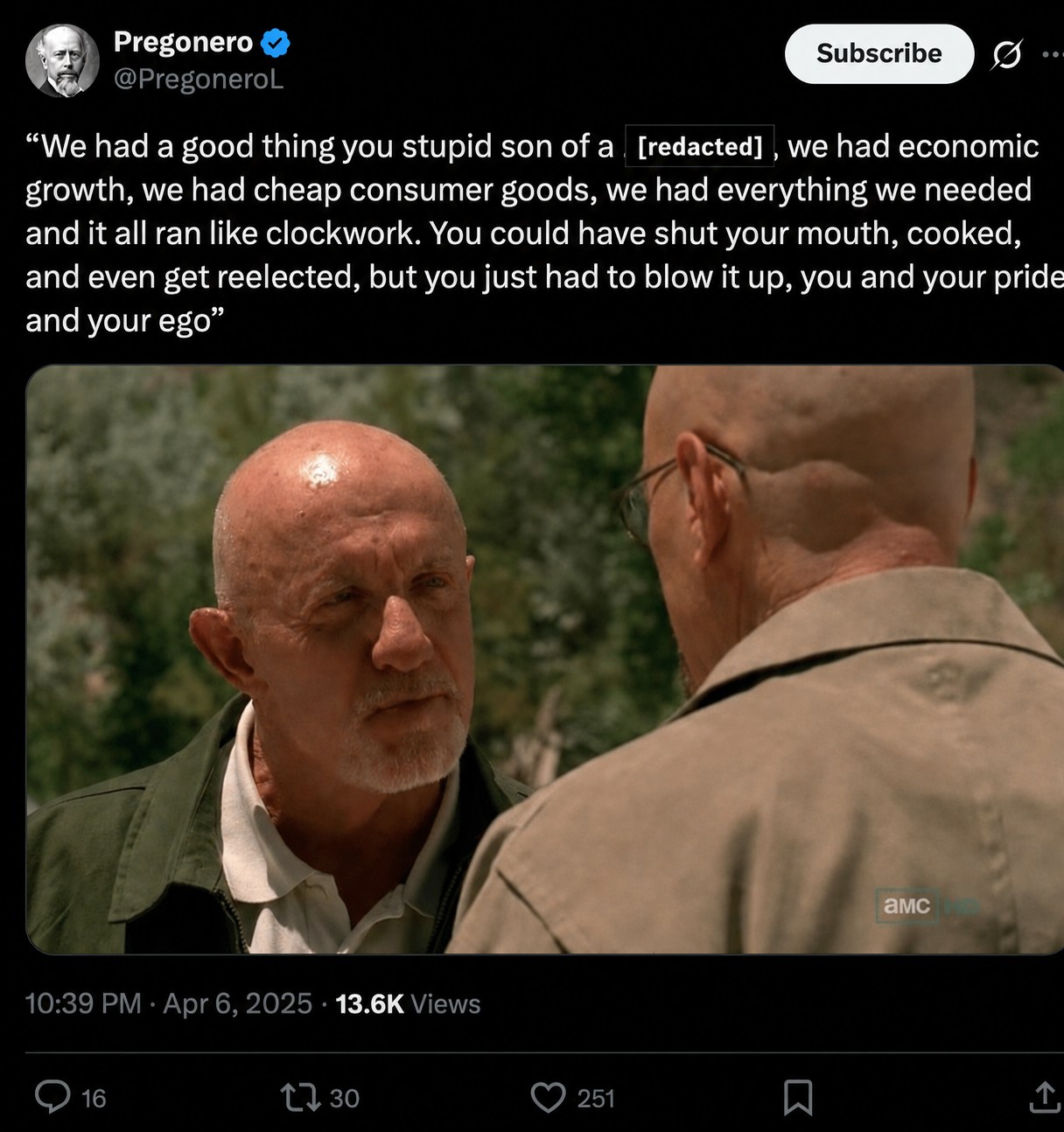
And multiple recent reports indicate that this narrative is correct.
How Trump slowed US economic growth
To understand how Trump’s most destructive policies have harmed the economy, one needs some sense of what American economic life would look like today in the absence of those measures.
Of course, this is impossible to know with certainty; we don’t have a time machine or access to an inter-dimensional wormhole. But economic analysts have done their best to sketch what growth and inflation would look like in that alternate universe.
Let’s start with GDP. According to the Peterson Institute for International Economics, tariffs reduced America’s growth rate in 2025 by 0.23 percentage points. But as the Economist notes, this figure likely understates the full impact of Trump’s tariffs, as it does not account for their impact on investor uncertainty.
When a business decides whether to sink capital into a new project, it must weigh the risk that unforeseen circumstances will reduce their investment’s profitability. For this reason, according to conventional wisdom, the more volatile the market and policy environment is, the more likely firms are to hoard their cash.
And outside of the booming AI sector, American businesses have indeed pared back investment. As the Economist observes, excluding artificial intelligence-related categories, business investment fell at a 3 percent annualized rate over the last four quarters — after rising at a 5 percent average rate over the preceding decade. This collapse in non-AI capital investment shaved about 0.4 percentage points off America’s 2025 GDP growth, according to the magazine’s analysis.
Meanwhile, without Trump’s immigration policies, America’s labor force would be substantially larger — and thus, US economic output would be higher. According to a Brookings Institution report, last year’s decline in immigration shaved as much as 0.26 percentage points off US GDP.
Taken together, these analyses suggest that economic growth would have been about 0.9 percentage points higher last year, were it not for Trump’s trade and immigration policies.
Precisely how much Trump’s war with Iran is slowing growth in 2026 is unclear. Much depends on the trajectory of the conflict. But most analysts believe that it has dampened output marginally. At the same time, Trump’s tariffs and immigration policies continue to weigh on the economy.
Trump has engineered higher prices
The data on inflation tells a similar story. Trump’s tariffs have raised import costs for businesses that’ve passed on part of that burden to consumers. As a result, prices are rising much faster in the United States than they otherwise would be, according to a recent report from the Dallas Federal Reserve.
In that analysis, the bank plots America’s core inflation rate over time and compares this to what that rate would have been in the absence of all tariff impacts. The two lines diverge sharply after “Liberation Day,” when the president slapped large tariffs on virtually all of America’s trading partners (these rates were later pared back by both the administration and a Supreme Court ruling, but most remain far above their pre-Trump levels).
Judging by the Fed’s calculations, as of this March, America’s core inflation rate would have been just 2.3 percent — instead of 3.2 percent — in the absence of Trump’s tariffs.
And this does not account for the Iran War’s price impacts. A separate paper from Federal Reserve economists estimates that a three-month closure to the Strait of Hormuz would add 0.35 points to headline inflation. If that waterway remains shuttered for six months, that figure jumps to 0.79 points. After 9 months, it hits 1.47 points.
In other words, without Trump’s tariffs and warmaking, America’s inflation rate would likely be more than one point lower today (and not that far off the Fed’s 2 percent target).
What’s more, in that alternate-universe United States, Americans would not just enjoy lower prices but also lower borrowing costs. As is, persistent inflation has constrained the Fed’s willingness to lower benchmark interest rates while motivating private lenders to offer less generous terms. Since the War with Iran started in late February, mortgage rates have climbed.
We had a good thing
For all this, America’s economy is still growing. And inflation isn’t exceptionally high by historic standards, though it remains elevated.
Yet, the economy’s resilience is largely attributable to tailwinds disconnected from Trump’s trade, immigration, and foreign policies. The AI boom is catalyzing massive investment in data centers, software, and information processing technologies, while also lifting stock values — and, thus, the consumer spending of rich and upper middle-class households. At the same time, inflation was likely poised to decline when Trump took office, as supply chains continued normalizing after post-COVID shocks.
In short, as he once did earlier in life, Trump has squandered a fortuitous inheritance.
Recent Comments