



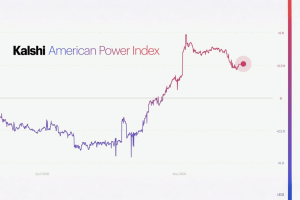
Kalshi has rolled out a new political benchmark that tries to capture the balance of power between Democrats and Republicans in a single number.
The product, called the Kalshi American Power Index, or KPOW, is now available on the company’s platform. Kalshi says the index combines current political control with market expectations about where power is likely to move next, creating a continuously updated reading of the U.S. political landscape.
Announcing the launch, founder and chief executive Tarek Mansour argued that the flood of political data has made it harder to understand the broader picture.
“The American Power Index (KPOW) is live,” Mansour wrote in a social media post. “One number, oscillating between Republicans and Democrats throughout the endless contest for power.”
How the Kalshi American Power Index works
KPOW runs on a scale from +50D, representing the strongest Democratic position, to +50R, representing the strongest Republican position. Kalshi says the measure blends institutional realities, such as who currently holds power, with signals from prediction markets about future outcomes.
The company places greater emphasis on forecasts than present conditions. According to Kalshi, 75% of the score comes from forward-looking market expectations, while 25% reflects current political control.
“The ‘future’ leg captures where markets believe political power is heading; the ‘current’ captures where it actually stands today,” Kalshi said in materials accompanying the launch. “Blending the two at 75% on future and 25% on current produces an index that moves meaningfully with market sentiment while remaining anchored to certified political reality.”
Mansour said the goal is to create a single gauge that adjusts as events unfold rather than forcing observers to track numerous disconnected indicators.
“The index captures the wave: a unified aggregate metric that updates as the world changes,” he said.
The launch arrives as prediction markets face growing scrutiny from regulators and lawmakers. Earlier this year, Kalshi announced new safeguards designed to stop politicians, candidates, athletes, referees, and sports personnel from trading in markets connected to events they could influence. The company also disclosed enforcement actions against three political candidates it said violated exchange rules by trading on markets tied to their own campaigns, resulting in suspensions and financial penalties.
At the same time, lawmakers have introduced the BETS OFF Act, legislation aimed at restricting markets linked to government actions and other events where insiders may possess advance knowledge. Sen. Chris Murphy, one of the bill’s sponsors, criticized such contracts, saying, “These are fundamentally corrupt markets. They are rife with insider trading, and they offer incredibly perverse incentives, especially inside the government.”
Against that backdrop, KPOW marks Kalshi’s latest effort to spread beyond individual event contracts and build indicators from prediction-market data, even as debate continues over how those markets should be regulated.
Featured image: Kalshi via X
The post Kalshi launches political power index amid scrutiny over prediction markets appeared first on ReadWrite.
Recent Comments