



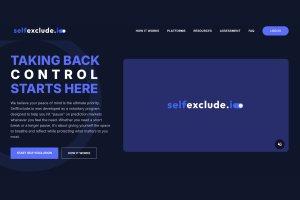
A new scheme aimed at protecting consumers in the US has opened up amid the fast-growing world of prediction markets. Kalshi has become the first platform to fully plug into a shared self-exclusion network called SelfExclude, a system designed to let users step away from trading across multiple platforms all at once. The tool is run by IC360, a global compliance technology and advisory platform, and more companies, including Polymarket, Robinhood, and ProphetX, are expected to connect to it.
Instead of forcing users to manage limits one account at a time, users can enroll once, and the restriction follows you everywhere that participates.
What is SelfExclude and how does prediction market self-exclusion work?
According to the FAQs, SelfExclude.io gives users a way to voluntarily block themselves from prediction market trading across a growing list of platforms. Rather than toggling settings on each individual app, people can sign up a single time and have that decision applied broadly.
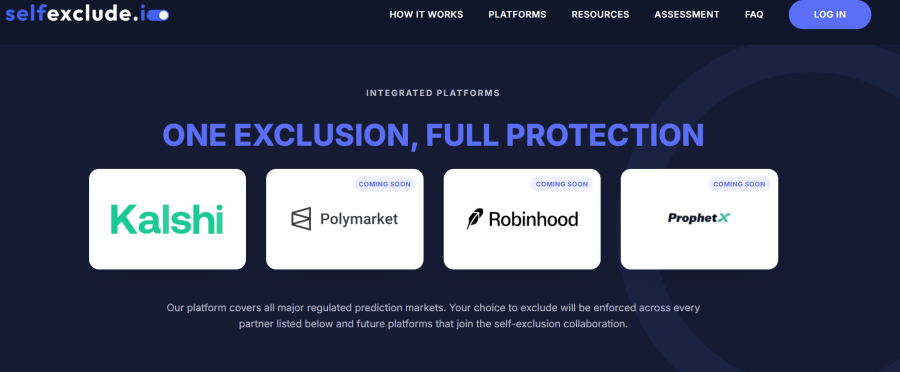
The idea is to make it easier to take a break without friction. Someone who feels they need distance from trading can act quickly, without juggling multiple logins or remembering where they hold accounts, in order to support better financial habits by lowering the barrier to stepping away.
Behind the scenes, the system is attempting to focus on privacy. A user’s identity is verified first, then converted into encrypted and anonymized data. Participating platforms can check whether someone is on the exclusion list, but they never see the underlying personal information. That way, enforcement works without exposing sensitive details.
Why is Kalshi joining SelfExclude ‘a big deal’?
Kalshi’s participation stands out because it is the first federally regulated prediction market to adopt a shared exclusion system like this.
Sara Slane, Head of Corporate Development at Kalshi, stated the importance of a unified approach. “This is a big deal,” she said. “It underscores the fundamental advantage of a federal framework: the ability to provide consistent, nationwide customer protections, rather than relying on a disjointed state-by-state system.”
This is a big deal. It underscores the fundamental advantage of a federal framework: the ability to provide consistent, nationwide customer protections, rather than relying on a disjointed state-by-state system.
https://t.co/ZidtJfhtXV
— Sara Slane (@Sara_Slane) April 10, 2026
In her view, the problem hasn’t been a lack of willingness from companies or regulators. Instead, it has been the structure of the system itself. “Having worked in the industry, I saw this firsthand. It wasn’t a lack of effort or intent from operators or regulators. The problem was structural. Conflicting state laws made it virtually impossible to implement consistent, effective protections,” Slane said.
This has reportedly shaped how safeguards are built (or not built) across the market.
How do you self-exclude from prediction markets?
For users who want to opt out, the process starts on the SelfExclude platform. From there, they go through an enrollment flow that confirms their identity. This requires standard personal details such as a legal name, address, date of birth, phone number, and a government-issued ID, helping ensure that only the account holder can trigger the restriction.
Once verified, users pick how long they want the exclusion to last. Available timeframes typically range from one month up to a year. After submission, the system processes the request and pushes it out to participating platforms, usually within about 24 hours.
During that period, users are generally blocked from opening new trades. Some platforms may still allow them to close out existing positions, but the core function i.e. placing new bets or trades is restricted.
Can you ban yourself from Kalshi?
Kalshi already offers its own built-in self-exclusion tools. Users can request to stop trading for a set period directly through the company’s website, API, or mobile app.
What changes with SelfExclude is the scope. Instead of the restriction applying only within Kalshi, it extends across multiple platforms at once. That wider reach is what makes the integration notable, especially for users who operate on more than one exchange.
How does SelfExclude protect your privacy and personal data?
Rather than sharing raw personal data, SelfExclude says it relies on a double-hashing process that transforms user information into encrypted values before anything is stored.
When platforms check the database, they run the same hashing method and receive a simple response: match or no match. No names, IDs, or contact details are ever exposed in that exchange.
Because of this structure, even the stored data cannot be reverse-engineered to reveal someone’s identity. All communication is encrypted, and the system is built specifically to avoid holding reconstructable personal information.
Why was cross-platform self-exclusion difficult before?
Efforts like this have historically run into issues regarding fragmented regulation, particularly in the United States. Different states enforce different rules, and those differences have made coordination difficult.
Slane pointed to how that played out in practice. “A clear example was self-exclusion: we were often prohibited from sharing self-exclusion customer lists across state lines, limiting our ability to safeguard individuals who needed it most. This is where regulatory fragmentation can lead to unintended consequences,” she said.
In many cases, that fragmentation shifted responsibility onto users themselves. “Instead of prioritizing the customer, stakeholders are forced to navigate a maze of inconsistent requirements. And who gets overlooked…the customer.”
What happens after your self-exclusion period ends?
When the selected exclusion period runs out, access is automatically restored. Participating platforms are notified, and normal account functionality returns without the user needing to take additional steps.
At any point during the exclusion, users can log in to check their status, see how much time remains, or choose to enroll again if they want a longer break.
One key rule is that the exclusion cannot be reversed early. Once a timeframe is chosen, it remains in place until it expires. The intention is to prevent spur-of-the-moment decisions from undoing what was meant to be a protective measure.
What’s next for SelfExclude and prediction market regulation?
With additional companies already in the pipeline, the network could increase quickly and become a standard layer of protection across the industry.
Slane sees this as part of a general move toward more consistent safeguards. “Supporting a federally regulated exchange doesn’t mean opposing state-regulated, house-backed sports betting. Both models can coexist,” she said. “The key difference is that a federal framework enables consistent, nationwide protections, ensuring that customers receive the same safeguards regardless of which state they are located.”
Featured image: SelfExclude.io
The post How do you self-exclude from prediction markets? Kalshi joins SelfExclude network appeared first on ReadWrite.
Recent Comments