




A while back, I was at physical therapy, and the topic of tennis came up. Someone said something about yellow tennis balls, and I was like… “What? They’re green.” And then someone else chimed in, “No, they’re yellow!” And then someone across the room hollered, “No, they’re obviously green.”
There was basically a physical therapy uproar. And when I started asking other people how they saw them — yellow or green — they told me they couldn’t even believe there was a debate. So I called up Bevil Conway. He’s a neuroscientist who heads up a lab at the National Eye Institute. He’s working on a book called Color Coded, which is due out next year. And he’s also a working artist — which is actually how he got into studying color in the first place.
Conway told me there’s a pretty good reason for why so many people disagree about tennis balls. He said it’s simple: “There’s no such thing as a color.”
In the latest episode of Unexplainable, I talked with Conway about what color even is, the viral dress fight (black and blue or white and gold?), and why we get so upset when people don’t see color the same way we do. Below is an excerpt of our conversation, edited for length and clarity. Listen to the episode anywhere you get your podcasts or you can watch on Netflix.
So you are an artist. You are also a neuroscientist. You study color. You’re also working on a book about color. Are there still color mysteries? Are there things science doesn’t know about color?
There are lots of mysteries about color. For a long time, people thought that color was a little bit like a filter, that everything that’s really important is in black and white, and then there’s a color filter you put on top of it.
But a bunch of years ago, my lab were blown away to discover that there’s as much brain involved in processing color as there is in face recognition.

The same amount of processing power?
Yeah, there’s tons and tons of tissue [and] pretty fancy bits of brain that are doing pretty high-level things — parts of brain we think of as being involved in social cognition and in high-level reasoning and visual memory. Color must be more than just this little add-on. It’s doing something much deeper. So we’re trying to understand what those bits of brain are doing.
So what is color? How does it work? How do our brains and eyes perceive it?
The classic definition would be: Color is the visual feature that you get from wavelength properties of the light entering your eye. People typically see the long wavelength end as red light, and then going through short wavelengths, you know, following ROYGBIV: red, orange, yellow, green, blue, indigo, violet.
If color were just wavelength, then an object under blue light would look blue, and the same object under yellow light would look yellow. And that wouldn’t be very helpful — because what you want is a signal that tells you about objects, immune to the lighting condition. You want them to always have that color.
A perfect example is a peach. If you look at a peach outside and you look at it inside, it’s always gonna look like a peach color. But if you looked at the pattern of wavelengths that are coming off of the peach, they’re very different under different lighting conditions. They should be different colors if color were just wavelength, but they’re not. Those two different compositions of wavelengths look the same color.
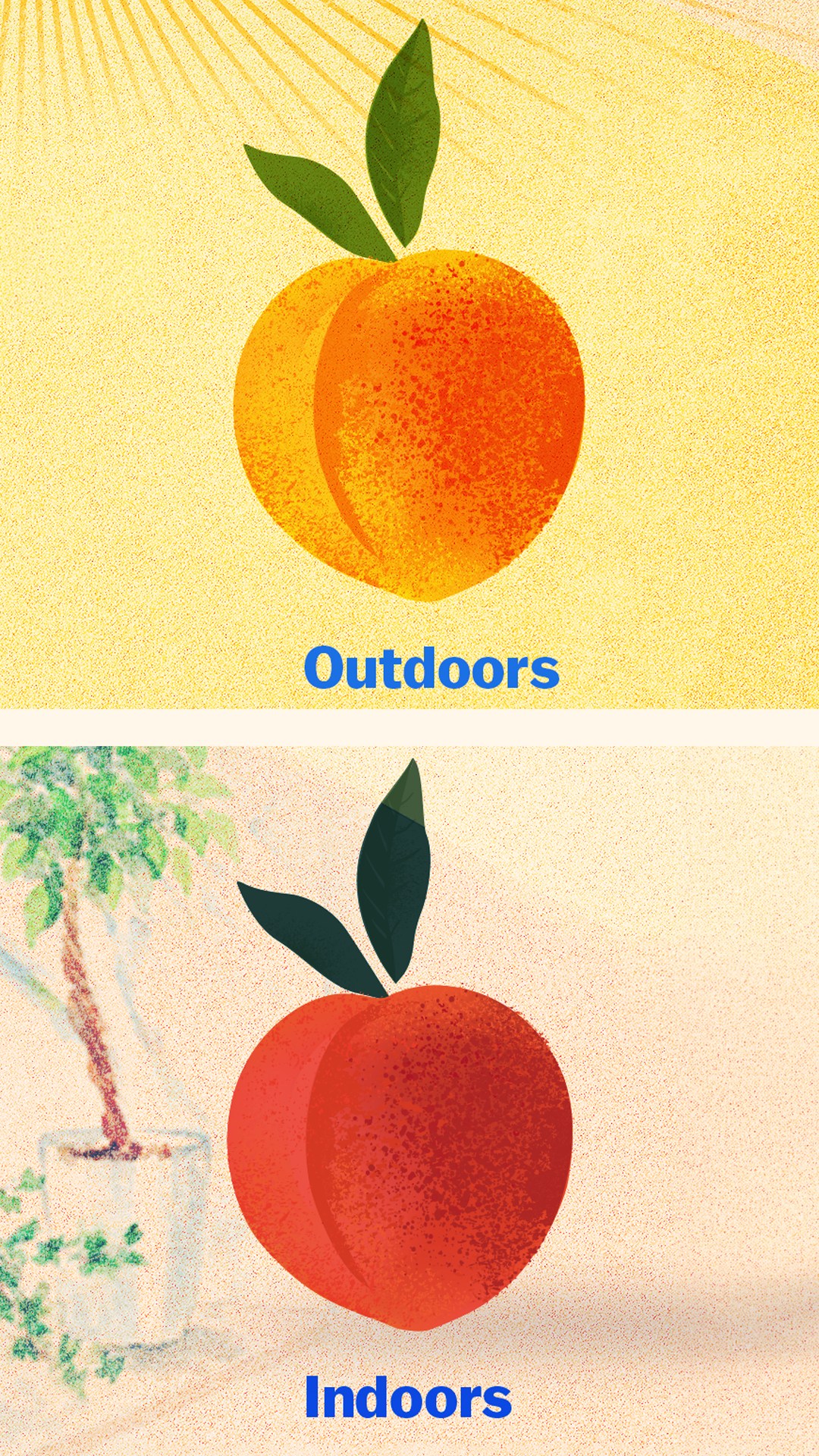
What I think is so cool about color is it’s so fundamental for how we need to experience the world — but the mechanics of how it does it teaches us a lot about the brain.
What we’re talking about is color constancy. That is, an object’s color is constant despite the viewing conditions.
So if the peach is fundamentally a different color inside and outside, and our brains are telling us that it is still, you know, peach colored, how are our brains deceiving us?
So it’s not fundamentally a different color. It’s the same color. That’s the cool thing. The problem is that you are carrying around, Noam, in your head an idea that color is wavelength, and that is the mistake.
Color is not wavelength! And we’ve known this for a long time. But the problem is that we want something that is an empirical, measurable number that’s outside of an observer, that’s a thing out there in the world, that would be the same number regardless of who looks at it. And color, at its core, is not that.
Color is dependent on your own visual system interacting with the world. And that doesn’t mean it’s any less real. It just means that its reality is dependent on psychological neural brain processes. And that’s what makes color fascinating.
Color is, you’re saying, something that is essentially created in the brain.
Absolutely, yes. Color is a generative product of the brain that gives us reliable, useful, true, meaningful, objective information, but it itself is not [those things]. It’s some generative product of your brain in order to come up with this information that’s useful and meaningful about the world.
[Your brain is] actually creating that thing that is a color. Colors don’t exist out there in the world independent of a viewer to see them.
Is this related to “the dress” — you know, like 10 years ago when that photo of a dress went viral, and a bunch of people on the internet thought it was blue and black, and a bunch of other people thought it was white and gold, and everyone got super upset? Is this the same type of thing, of seeing something in different lighting or different contexts and perceiving a different color?
It is. So the dress was fascinating because people with normal color vision looking at exactly the same thing were asserting very different perceptions.
And, you know, from a deep kind of philosophical point of view, it’s important because they weren’t saying, “Yeah, it kinda looks different to me, but I understand how you could see it as different.” They were like, “No, it is white and gold.” And other people were saying, “It is different colors.” That was, for me professionally and personally, a really big deal because it underscored this fact that color is this generative, constructive thing that your brain is doing, making all kinds of assumptions, filling in the gaps about lighting, about what you think you’re seeing.
In the case of the dress, it’s such a crappy little photograph, very blurry. It doesn’t give you a lot of context. And your visual system, your own brain, has to make a guess about what the lighting is. And if your brain guesses that the lighting is nice, warm, direct sunlight, then it implicitly subtracts out a little bit of the yellow from the image, and you see it as blue and black. Whereas other people looking at exactly the same pixels on the same monitor who assume that the lighting is cool, indirect, shaded light from blue sky, their brains color-correct the image, subtract out some of the blue, and they see it as white and gold. And so you have these two groups of people whose brains have just made different assumptions.
Why do you think that left people feeling so unnerved? When this happened, people could not possibly believe someone else could look at that dress and see a different color.
It was amazing! And, you know, it’s still, to date, I think, the most viral image in the history of the internet. Right when it came out, my initial reaction too was like, “Huh, that’s weird. I wonder what’s going on there.” And a lot of my colleagues thought, “Well, maybe it’s got to do with proportions of rods and cones, or people are looking at different displays, or maybe people are just silently color blind.”
But I think the idea that your own brain could play such a fundamental role in determining what the pattern of wavelengths means, even for vision scientists, wasn’t sitting front of mind.
I think the reason that it played so deeply, if I could wax poetic, it’s that our contemporary society depends on a shared experience, right? Our laws depend on a common idea of what’s right and wrong.
Yeah, like whether my red is your red; we still need to be able to point at something and agree that it’s red.
Yes, and here was an example where it was like: “That isn’t white and gold, that’s blue and black, clearly. Do we live in a shared reality?”
And if you can’t trust your eyes, what can you trust? I think people genuinely felt like, “Is this the beginning of the end?” Like, “Is our whole society collapsing?” I mean, look at Twitter, there were all sorts of expletives flying around.
Have you ever gotten into an argument about a color? I once got into an argument about tennis balls and what color they were.
Yeah, what color are they? I’m curious.
I couldn’t believe anyone thought they were yellow! I always thought they were green.
They’re totally yellow. I mean, we can get into one now. You’re wrong. It’s so funny — I really thought that they were definitionally yellow.
So what is going on with tennis balls?
Tennis balls are funny. I mean, if you ask people to pick their best example of green and blue and red and orange and yellow and so on, there’s a lot of variability. Green and blue is the most variable. Some people’s best example of green is another person’s best example of blue.
Meaning, you could ask me to pick a color that would be perfectly green, and then someone else would be like, “No, that’s blue.”
Yeah, exactly. And this isn’t language-based. This is true across all cultures.
We just perceive blues and greens kinda badly or vaguely?
Yeah, and one of the ideas that we have about that is that blues and greens aren’t really the colors that are tied to objects.
So if I ask you what colors are objects, it’s a weird question! It’s like, objects can be any colors. But it turns out, if you actually go and measure, you know, the colors of things that you choose to label in the world, most of them are, like, yellow, brown, red, pink, some purples, not many.
Yeah, I guess green and blue is the background. Like green’s the forest, and blue is the sky.
Yeah, exactly. And, and even in nature, there are very few natural blue objects, and that’s partly what made blue as a pigment so desirable. So what’s weird about yellow is that yellow, if you just ask people in the rainbow to pick where yellow is, people are incredibly consistent.
So people really know yellow.
They really know yellow. And I think what’s going on with the tennis ball is that it is a little bit fluorescent. It’s actually emitting a little bit more light than it’s taking in because it’s reprocessing it, short-wavelength light in the visible spectrum.
So they’ve picked this bright yellow, which is right at the peak of our visual system sensitivity. So the color of the tennis ball is the optimal wavelength that we can detect with our eyes, and it’s right in that range where it’s technically probably closer to green than it is to yellow. But because it’s so bright, and yellow is considered a bright color, the brightest color, people could be persuaded to see it in a yellow direction.
What I hear you saying is that I’m right — and it’s green.
Yeah, yeah. Although, I still like it as yellow.
Recent Comments