



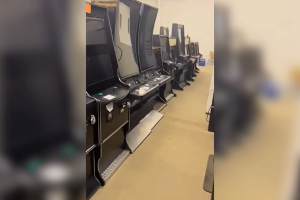
Two western Pennsylvania amusement businesses have admitted to felony corrupt organizations charges in a case involving hundreds of illegal video gambling machines, Attorney General Dave Sunday announced.
Buffalo Skills Games, Inc. and J.J. Amusement, Inc. will shut down as part of the plea deal and give up $5 million in assets. Investigators also pulled nearly 400 illegal machines from more than 60 sites spread across multiple counties, the attorney general’s office said. The devices were found in everyday locations like bars, gas stations and convenience stores throughout Allegheny, Beaver, Butler, Cambria, Crawford, Indiana, Somerset, Venango, Erie, Washington, Armstrong and Westmoreland counties.
”This resolution secures a multimillion-dollar forfeiture for the Commonwealth, while assuring the companies will cease to exist,” Sunday said. “I commend our partners at the Pennsylvania State Police for helping disband a large-scale operation that involved slot machines essentially dressed up as skill games.”
Authorities first outlined the case publicly in May 2025, when they revealed the seizure of more than 400 machines and filed felony charges against the two companies. Prosecutors said at the time that both businesses were owned and run by John F. Conley, who has prior federal convictions tied to illegal gambling.
Background to the Pennsylvania illegal amusement firm operation
The connection to Conley allegedly traces back decades. In a 1996 decision, the U.S. Court of Appeals for the Third Circuit described him as the driving force behind what it called the largest video poker gambling operation in the Pittsburgh region. At its peak, the court said, the business stretched across hundreds of locations and relied on thousands of machines, bringing in millions of dollars.
Court records outlined how the operation worked. Machines equipped for gambling were placed in bars and similar establishments, with profits split between the business and location owners. Employees handled everything from recruiting sites to maintaining the machines and collecting cash.
Between 1985 and 1990, more than $10 million flowed into bank accounts tied to Conley or his workers, according to the ruling. The court estimated that roughly 93% to 94% of that money came directly from video poker gambling activity.
The opinion also detailed how Conley continued operating even after a 1988 conviction in Allegheny County for violating state gambling laws. As pressure from law enforcement mounted, the business structure shifted. Ownership of machines was moved into newly created companies, and nominal owners were installed while control remained centralized.
Sunday said the current case centers on illegal chance-based machines rather than legal skill games.
“Illegal gambling operations are not victimless crimes,” Sunday added. “They can fuel criminal enterprises, exploit individuals addicted to gambling, and rip off consumers with games that are not regulated, provide little or no chance of winning, and do not comply with gambling self-exclusion lists intended to protect those struggling with addiction.”
The attorney general’s Gaming Enforcement Section handled the prosecution.
Featured image: Pennsylvania Attorney General
The post Two Pennsylvania amusement firms plead guilty in illegal gambling case, as former kingpin agrees to pay $5M appeared first on ReadWrite.
Recent Comments